When someone asks an AI search tool to recommend a local company, the system needs enough reliable information to understand who the business is, what it does, where it operates, and whether the available information supports the recommendation.
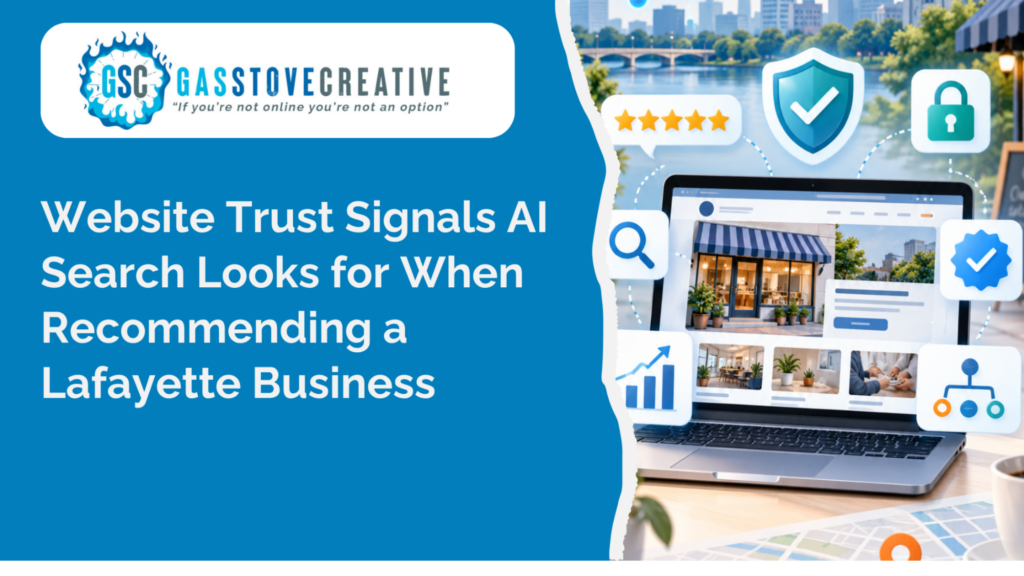
For Lafayette businesses, the most useful website trust signals include clear business information, real expertise, accurate service details, consistent local data, customer reviews, original content, strong author information, secure website technology, structured data, and independent references from other trusted websites.
That does not mean AI search engines use a simple checklist or automatically recommend a company once it adds these items. Google states that there are no special technical requirements or special schema markup needed to appear in AI Overviews or AI Mode. Instead, the same strong SEO practices that help traditional search remain relevant to generative AI search.
That makes trust especially important when choosing an SEO agency that Lafayette, Indiana business owners may work with. The goal should not be to manufacture signals for AI. The goal should be to make your real experience, business identity, services, reputation, and expertise easy for both customers and search systems to verify.
This guide explains the signals worth improving and which shortcuts Lafayette businesses should avoid.
What Does a Trust Signal Mean in AI Search?
A trust signal is information that helps users and search systems understand whether a business or its content appears credible, accurate, useful, and connected to a real organization.
Trust can come from your website, but it does not come from your website alone.
Search systems can find information from sources such as:
- Your official website
- Google Business Profile
- Customer reviews
- Local directories
- Industry organizations
- News websites
- Professional profiles
- Business databases
- Links and mentions from other websites
- Structured data
- Publicly available business information
Google explains that local listing information can come from the business’s official website, licensed third parties, user contributions, Business Profile data, and other information Google gathers about a place.
This is why consistency matters.
If your website says you serve Lafayette, your Google Business Profile says West Lafayette, and an old directory lists an address you left three years ago, a potential customer may have trouble understanding which information is correct.
Machines face a similar entity-resolution problem.
Does Google Have Special Ranking Factors for AI Search?
Not in the way many marketing claims suggest.
Google says its AI search features remain connected to its core Search ranking and quality systems. Pages that may appear as supporting links in AI Overviews or AI Mode need to be indexed and eligible to appear in Google Search.
Google also says website owners do not need:
- Special AI schema
- An AI text file
- Separate pages for every AI prompt
- A special AI-only technical setup
Instead, Google recommends established SEO fundamentals, including crawlability, useful content, internal links, strong page experience, accurate structured data, and current Business Profile information.
That is an important distinction.
Do not build your website around guessing what an AI system might prefer. Build a website that clearly demonstrates why real customers should trust your business.
Which Website Trust Signals Matter Most?
The following signals create a strong foundation for local search, traditional organic search, and AI-driven discovery.
| Trust Signal | What It Helps Establish |
| Complete business details | Business identity and location |
| About and team pages | Real people and expertise |
| Reviews | Customer experience and reputation |
| Service pages | What the company actually provides |
| Original content | Knowledge and first-hand experience |
| Local information | Geographic relevance |
| External mentions | Independent corroboration |
| Structured data | Machine-readable business details |
| HTTPS and site quality | Safe, professional experience |
| Updated information | Accuracy and reliability |
No single item guarantees inclusion in an AI-generated answer.
The strongest approach is to make these signals work together.
How Does Clear Business Information Build Trust?
Start with the basics.
Your website should clearly explain:
- Your business name
- What you do
- Who you serve
- Where you operate
- How customers can contact you
- Your business hours when relevant
- Your main services
- Your team or ownership when appropriate
Google recommends keeping Business Profile information complete and accurate. It specifically notes that detailed information helps Google understand and match businesses with relevant local searches.
Keep Local Information Consistent
For a Lafayette service business, check your important profiles and make sure basic information does not conflict.
Suppose a plumbing company moved from one Lafayette location to another.
Its website may show the new location, while an old local directory still shows the previous address. The company should update important sources rather than creating more listings with conflicting information.
Accuracy matters more than creating hundreds of low-quality citations.
Why Do About and Team Pages Matter?
People want to know who is behind a business.
Search quality concepts also emphasize experience, expertise, authoritativeness, and trustworthiness, commonly called E-E-A-T. Google added the second E for experience to recognize cases where first-hand knowledge is useful.
For a local company, an About page can explain:
- Who founded the business
- How long the team has worked in the field
- Relevant professional experience
- Certifications or licenses
- Local connections
- Areas of specialization
- How the company approaches its work
Your team page should not exist only to target keywords.
It should help someone answer a simple question:
Who am I trusting with this service?
For businesses building a stronger digital presence, a clear About GasStoveCreative page is one example of where company background and identity can be communicated.
How Important Are Customer Reviews?
Reviews are one of the most visible forms of third-party trust.
Google Business Profiles can display review scores, individual reviews, and total review counts. Google also says review quantity and positive ratings can contribute to local prominence.
But businesses should never treat reviews as something to manipulate.
Google prohibits offering incentives in exchange for reviews, changed reviews, or removal of negative feedback.
Build Review Trust Naturally
A healthy review process can include:
- Asking real customers for feedback
- Making the review process easy
- Responding professionally
- Addressing reasonable complaints
- Avoiding fake or purchased reviews
- Keeping testimonials truthful
Reviews are most useful when they reflect real customer experiences.
A Lafayette homeowner reading specific feedback about communication, timing, workmanship, or service quality gains far more information than from a page filled with vague five-star testimonials.
Why Does Original Experience Matter for AI Search?
Generic content is easy to reproduce.
Experience is harder to copy.
Google’s 2026 generative AI search guidance specifically encourages content that offers original experience, a useful point of view, and information beyond what could easily be summarized from other websites.
For a Lafayette business, that may mean publishing content about:
- Problems you commonly see locally
- Questions customers ask during estimates
- How your process works
- Before-and-after examples
- Real project lessons
- Local conditions that affect your work
- Common mistakes you help customers avoid
Example: Generic vs. Experience-Based Content
A generic roofing article might say:
“Regular roof inspections can help find damage.”
An experience-based article might explain:
“After severe spring storms in Tippecanoe County, our team commonly checks flashing, shingles, gutter edges, and areas around roof penetrations first because these are places where homeowners often notice leaks.”
The second version gives readers something useful.
Do not invent experience. Use knowledge your company actually has.
How Can Service Pages Strengthen Business Credibility?
A strong service page should clearly describe what a business actually provides.
Avoid creating dozens of thin pages that only swap city names or keywords.
Google warns against producing large numbers of pages mainly to manipulate rankings or cover every possible query variation. Its generative AI guidance recommends useful, non-commodity content instead.
A useful service page can explain:
- What the service includes
- Who may need it
- Problems it addresses
- What customers can expect
- Service limitations
- Geographic coverage
- Frequently asked questions
- The next step
If your website struggles to explain its services clearly, reviewing your website development and design may help identify where the user journey needs improvement.
What Role Does Structured Data Play?
Structured data provides search engines with standardized information about a page and the organization behind it.
For local businesses, appropriate markup may include Organization or a specific LocalBusiness subtype.
Google recommends providing relevant organization details and says LocalBusiness markup can communicate information such as business hours and administrative details.
Useful properties may include:
- Business name
- URL
- Logo
- Address
- Telephone number
- Business type
- Hours
- Geographic details
However, schema should support visible information rather than replace it.
Google specifically recommends making sure structured data matches the visible content on the page.
Do not add awards, ratings, services, addresses, or credentials to schema unless they accurately describe the business.
Why Do Independent Mentions Matter?
A company describing itself as trusted is not the same as another credible organization independently referring to it.
Independent mentions can help reinforce business identity and reputation.
Examples may include:
- Local chamber membership
- Industry association profiles
- Local news coverage
- Supplier directories
- Professional organizations
- Community partnerships
- Legitimate business directories
- Interviews
- Event sponsorship pages
The goal is not to collect random backlinks.
Focus on relationships and sources that make sense for the business.
A Lafayette company involved with a local nonprofit, professional group, event, or trade organization may naturally earn references that confirm its connection to the community.
How Important Is Website Security?
Trust can disappear quickly when a website looks unsafe.
Business websites should use HTTPS and maintain current software.
Visitors may hesitate to complete a contact form if the browser displays a security warning. Outdated plugins, broken pages, spam injections, or suspicious redirects can also damage the customer experience.
Basic maintenance should include:
- HTTPS
- CMS updates
- Plugin updates
- Backups
- Strong passwords
- Multifactor authentication when available
- Malware monitoring
- Removing unused software
Website trust is not only about content.
The site itself must function like a legitimate business property.
What Content Should Lafayette Businesses Publish?
Think about the questions your real customers ask before buying.
Useful topics might include:
- How a service works
- When someone needs it
- Common pricing factors
- Local regulations when relevant
- Service comparisons
- Maintenance advice
- Warning signs
- What happens during an appointment
- Questions to ask a provider
The purpose should be to answer the question, not simply create another indexed page.
Google’s people-first content guidance says content should primarily exist to help visitors rather than attract search traffic.
For businesses developing a broader organic strategy, professional SEO services can connect technical optimization with useful content rather than treating them as separate activities.
Which Trust Signals Should You Avoid Faking?
Do not manufacture credibility.
Avoid:
- Fake reviews
- Fake author profiles
- Invented awards
- False certifications
- Fake office addresses
- Inflated experience claims
- Purchased testimonials
- Misleading statistics
- Unsupported “best in Lafayette” claims
- Schema that describes information not shown on the website
A trust signal becomes useful because someone can verify it.
A badge saying “Lafayette’s #1 Company” means very little if no identifiable organization issued the ranking.
Be specific instead.
If a business holds a license, identify the license when appropriate. If an employee has a certification, name the certifying body. If you publish a statistic, link to the original source.
How Can You Audit Your AI Search Trust Signals?
Use this simple quarterly checklist.
Business Identity
Check that:
- Your business name is correct
- Contact information works
- Service areas are accurate
- Business hours are current
- Your About page reflects the real company
Expertise
Confirm that:
- Important content has a clear author or business source
- Credentials are accurate
- Service descriptions reflect real capabilities
- Original experience appears where useful
Reputation
Review:
- Google reviews
- Customer feedback
- Important local listings
- Industry profiles
- Incorrect third-party information
Technical Trust
Check:
- HTTPS
- Indexing
- Mobile usability
- Broken pages
- Structured data
- Site security
- Page performance
Content Quality
Ask:
- Does this answer a real customer question?
- Is the information current?
- Does it add anything original?
- Can a visitor understand who created it?
- Are claims supported?
A website audit can also help identify technical, content, usability, and search issues that may be difficult to notice from inside the business.
Frequently Asked Questions
What are the most important trust signals for AI search?
Clear business information, first-hand expertise, accurate service pages, genuine reviews, external references, useful content, structured data, and a secure website all help establish a clearer and more trustworthy online presence. No individual signal guarantees an AI recommendation.
Does E-E-A-T directly determine AI search rankings?
Google uses E-E-A-T concepts when discussing content quality and its quality evaluation framework, but website owners should not treat E-E-A-T as a simple numerical score. Focus on demonstrating real experience, expertise, authority, and trust through useful and verifiable information.
Do Google reviews help AI search visibility?
Reviews provide useful third-party information about a business and can support local prominence. Google says review quantity and positive ratings can help local ranking. However, Google does not state that achieving a particular review count guarantees inclusion in an AI-generated recommendation.
Does schema markup help a local business appear in AI results?
Structured data can help Google understand business and page information, but Google says no special AI schema is required for AI Overviews or AI Mode. Schema should accurately reflect content already visible on the website.
Should Lafayette businesses create pages specifically for AI search?
Usually, no. Create pages because they answer useful customer questions or explain real services. Google’s guidance warns against generating many pages mainly to target query variations. Helpful, original content is the better long-term approach.
How long does it take to build website trust?
There is no fixed timeline. Business reputation grows through accurate information, useful content, real customer experiences, secure website management, local relationships, and consistent service. Search engines also need time to crawl and process changes.
Conclusion
AI search has not replaced the fundamentals of trust. A Lafayette business still needs to clearly show who it is, what it does, where it operates, why its team has relevant experience, and what real customers say about the company. Keep business information accurate, publish useful first-hand content, maintain a secure website, use honest structured data, build genuine local relationships, and make important claims easy to verify.
Those practices help real people make better decisions, which is the right foundation for traditional search and emerging AI search experiences alike. If your website does not clearly communicate those signals today, GasStoveCreative can help you evaluate the site, content, SEO, and broader digital presence without relying on shortcuts or unsupported AI visibility claims.